

Picture two people at the same crossroads. One is eyeing a ring that sits quietly on a finger all day. The other is looking at a mask that covers the eyes at night. Both promise to tell you how you slept, both cost real money, and both go about it in very different ways.
Quick answer: on pure measurement, smart rings currently have the longer public track record in validation research, and they collect data around the clock. A smart sleep mask is the only one of the two that also changes the sleeping environment, with darkness, warmth, sound and guided breathing, while it measures. Neither can replace a clinical sleep study.
So "which tracks better" is really two questions: how accurate is the data, and what do you do with it? We take both in turn.
What a smart ring and a smart sleep mask actually measure
It helps to know what is under the hood before comparing results. Most consumer sleep trackers combine two ingredients: an accelerometer for movement, and photoplethysmography (PPG), which uses light to read your pulse from the skin. From pulse and movement, software estimates heart rate, breathing patterns and, ultimately, when you were awake, in light sleep, in deep sleep or in REM.
Rings tend to add more signals. Oura, for example, says its staging algorithm draws on movement, temperature, heart rate and heart rate variability. A smart sleep mask uses the same family of sensing but from the face. Hypnuse lists a heart rate sensor, a pulse oximeter and a motion sensor in its sensor-equipped masks, with the results syncing to the Hypnuse app.
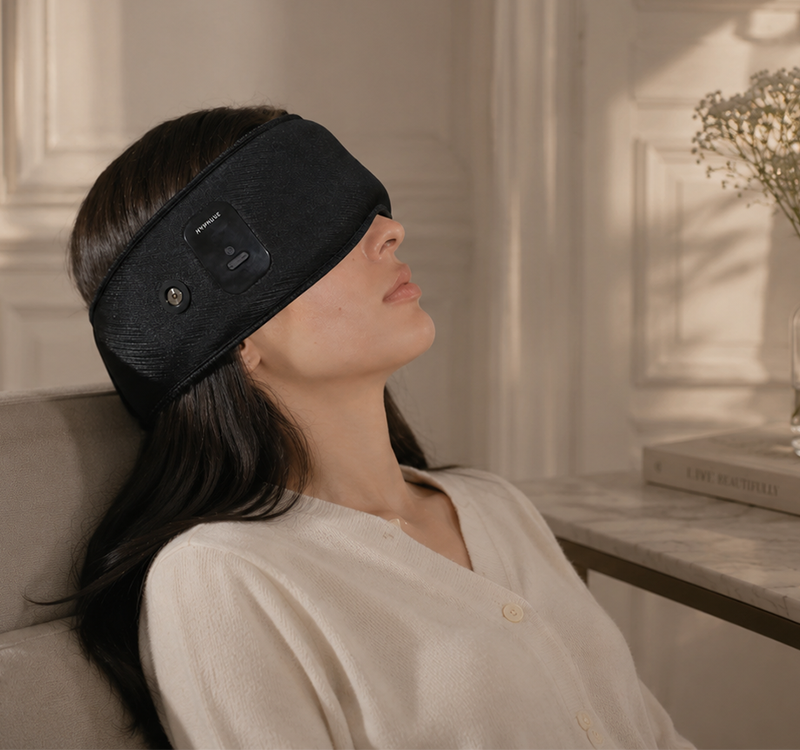
Here is the catch that applies to both devices. The gold standard for sleep staging is polysomnography (PSG), an overnight lab test that records brain waves. Neither a ring nor a mask reads your brain. They infer sleep stages from your pulse and movement, which makes every stage label an educated estimate rather than a measurement. Keep that in mind and the rest of this comparison makes more sense.
How accurate is consumer sleep tracking, honestly?
When researchers compare wearables against PSG, the simple question of asleep versus awake goes well. A sleep scientist at CQUniversity summarising the validation research notes that current trackers identify sleep with over 90% accuracy, though picking out quiet wakefulness is much harder, with accuracy ranging widely from about a quarter to nearly three quarters.
Stages are where things get fuzzier. The same summary puts wearables at roughly 53% to 60% correct for individual sleep stage epochs. An often-cited peer-reviewed study of a wrist-worn PPG device in the journal Sleep found about 91.5% accuracy for sleep versus wake, around 73% when sorting into three classes and around 59% for four classes.
Rings sit at the upper end of that range. Oura reports 79% agreement with PSG across four stages for its current algorithm, and a University of Tokyo study found its measurements did not differ significantly from PSG for several sleep metrics. One honest caveat: that study was partly funded by Oura, although the company says it played no part in the data analysis or writing. Independent replication matters, and the field is still catching up.
- Sleep versus wake: generally strong across devices.
- Total sleep time: usually close enough to be useful for trends.
- Sleep stages: estimates, with wide variation between devices and people.
- Diagnosis: not possible. The American Academy of Sleep Medicine states that consumer sleep technology cannot be used to diagnose or treat sleep disorders.
A mask uses the same sensing principles, so you should expect the same kind of limits: good for patterns, cautious about exact stage minutes. If you want to dig into what stage tracking can and cannot tell you, our explainer on sleep stage tracking and why it matters is a useful companion.
Where a smart ring has the edge
A ring has real strengths, and an honest comparison should say so.
It watches the whole day. Because you can wear a ring around the clock, it can connect how you slept to how active, stressed or recovered you were. That wider picture is something a bedtime-only device simply does not collect.
It has more published validation. Rings have been tested against PSG in multiple studies, including some independent of the manufacturer. If your top priority is a device whose accuracy has been examined in public, rings currently lead the category.
It is easy to forget you are wearing it. Some people dislike anything on the face at night. A ring on the finger asks nothing of you.
The trade-offs are just as real. Fit matters, since a loose ring can give noisy readings, and fingers change size with temperature and time of day. A ring also does nothing about the bright hallway light, the stuffy room or the thoughts racing at 11 p.m. It records the night. It does not shape it.
Where a smart sleep mask has the edge
A mask starts from a different premise: your sleep environment is part of the problem, so measure it and improve it at the same time.
It blocks light while it tracks. Hypnuse describes a patented 3D contour intended to close the gaps around the nose and cheeks, shaped using facial scan data from more than 2,000 participants. A ring cannot do that, however good its sensor.
It can act on your evening. On the Hypnuse Pro: Immerse Edition, that includes five heat levels from 38 °C to 46 °C, guided breathing, in-built speakers with 14 soundscapes, and an intelligent wake-up feature. Our guide to winding down faster with an AI sleep mask walks through how those layers work together.
It only runs when you sleep. That sounds minor, but it turns the mask into a ritual. Putting it on becomes the cue that the day is over, which is a different benefit from a ring quietly logging in the background. For the science behind that idea, see whether heat before bed really helps you fall asleep.

The honest downsides: not everyone enjoys wearing a mask all night, it has to be charged, and it gives you nothing during the day. It is also a sleep-routine product, not a medical device.
Smart sleep mask vs smart ring at a glance
| Factor | Smart ring | Smart sleep mask |
|---|---|---|
| Main job | Track sleep, activity and recovery | Support a wind-down and track the night |
| When you wear it | Day and night | Bedtime and naps |
| Blocks light | No | Yes |
| Heat, sound, breathing guidance | No | Yes, on supported models |
| Typical sensors | Heart rate, movement, temperature | Heart rate, pulse oximeter, movement (sensor-equipped models) |
| Public validation research | More published studies | Same sensing principles, so expect similar limits |
| Daytime insight | Yes | No |
| Best for | Long-term health and recovery trends | People who struggle to settle, or sleep in bright or noisy spaces |
Which one suits you best?
Think about your actual problem, not the feature list.
If you mostly want data about your health
A ring is the natural choice. It collects round-the-clock information, has a longer research record and is comfortable enough to forget. If you are curious about trends in recovery, stress or activity, it covers ground a bedtime mask never will.
If your trouble is switching off, light or noise
This is where a mask earns its place. Tracking tells you how a night went. Darkness, warmth, guided breathing and soundscapes try to change how it goes. The Hypnuse Pro: Immerse Edition ($249) is the full version with sensors, heat and sound. The Hypnuse Rhythm ($199) is the heating-led option in the same series, so check its product page for the exact feature list.
If you are on a budget or travel often
Not every Hypnuse mask tracks sleep, and that is fine. The Hypnuse Hush ($35) is a 100% blackout mask built for darkness. The Hypnuse Core ($15) is a non-electronic travel mask. Neither is a tracker, so pick them for the light blocking, not the data. Prices were listed on the Hypnuse site in October 2026 and may change.
Can you wear both?
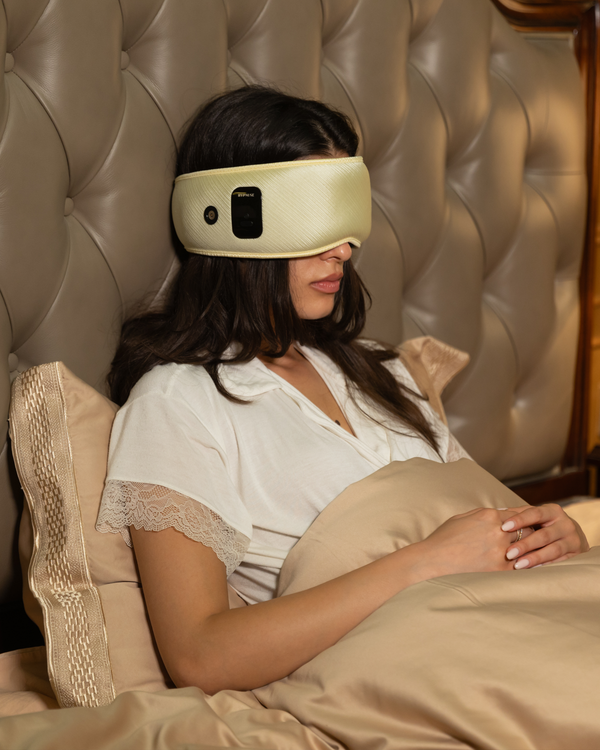
Yes, and plenty of people do. A ring covers the daytime and the long-term picture. A mask handles the evening and the sleeping environment.
If you try both, expect them to disagree sometimes. One may say you slept six hours and ten minutes, the other six hours and forty. That is normal, because each device is estimating from slightly different signals in slightly different places. Do not chase the "right" number. Look instead for whether both devices show the same direction over several weeks.
There is also a safety point worth stating clearly. Sleep tracking is not a health test. If you snore heavily, wake up gasping, or feel exhausted despite long nights, speak to a healthcare professional rather than a gadget. Our piece on how smart sleep masks monitor sleep apnea explains what this kind of data can and cannot show, and the CDC's sleep resources are a reliable starting point for general guidance.
How to read your sleep data without overthinking it
Tracking helps some people and creates score anxiety in others. A few habits keep the data useful.
- Look at weeks, not nights. One bad night tells you very little. A pattern across several weeks tells you much more.
- Trust total sleep and consistency first. Bedtime regularity and total hours are more reliable than the exact minutes in deep or REM sleep.
- Check in the morning, not at 2 a.m. Waking up to review numbers is a fast way to become more awake.
- Compare against how you feel. If the score says great but you are exhausted, believe your body.
- Change one thing at a time. Adjust a routine, wait a couple of weeks, then see what moved.
For routines to try, the Sleep Tips page collects short ideas, our guide to sleep hygiene covers the full-day picture, and the five-minute guided breathing routine is a gentle place to start tonight.
Frequently asked questions
Is a smart ring more accurate than a smart sleep mask?
Rings currently have more published validation research, so their accuracy is better documented. A mask uses similar sensing principles, so you should expect similar limits, especially for sleep stages. Neither is accurate enough to diagnose a condition.
Can a smart sleep mask track sleep stages?
Sensor-equipped masks collect heart rate, pulse oximetry and motion data and sync it to an app. Like any consumer wearable, stage labels are estimates rather than brain-wave measurements. Check the Hypnuse Pro product page for the exact metrics the app shows.
Do I need a ring if I already own a smart sleep mask?
Not necessarily. A mask covers nights and naps, while a ring adds daytime activity and recovery trends. If you only care about improving how you wind down, a mask alone may be enough.
Can either device diagnose sleep apnea?
No. The American Academy of Sleep Medicine says consumer sleep technology cannot be used to diagnose or treat sleep disorders. If you suspect sleep apnea, ask a doctor about a proper sleep evaluation.
Is a heated sleep mask safe to use every night?
Adjustable heat lets you start low and raise it only if it feels comfortable. If you have an eye condition or sensitive skin, ask your eye doctor first. Our comparison of heated and non-heated sleep masks covers the trade-offs.
The bottom line
If your question is purely "which gives me more health data," a ring is the stronger answer today. If your question is "which helps me actually sleep better while it watches," a smart mask is the only one of the two that does something about the night itself. Pick the tool that matches your real problem, use the numbers as a guide rather than a verdict.

Ready to explore? Start with the How It Works page, read our AI sleep mask wind-down guide, or compare the Hypnuse Pro and Hypnuse Hush at either end of the range.
Sources and further reading
- American Academy of Sleep Medicine: Consumer Sleep Technology position statement
- The Conversation (CQUniversity Australia): How do sleep trackers work, and are they worth it?
- Fonseca et al., Sleep (2017): Validation of photoplethysmography-based sleep staging compared with polysomnography
- Oura: Sleep Staging Algorithm 2.0 (manufacturer-reported)
- Oura: University of Tokyo validation study (partly funded by Oura)
- CDC: Sleep resources
This article is for general information and is not medical advice. Hypnuse masks are sleep-routine products, not medical devices.


