
Most people don't struggle with sleep because they can't close their eyes. They struggle because their mind and body haven't switched off yet. The inbox is still open in your head, your shoulders are still tight, and the room is never quite dark enough. By the time you lie down, you are asking your body to shut down from a standing start.
A regular sleep mask solves one part of that problem: light. An AI sleep mask tries to cover more of it. It blocks light, adds gentle warmth and sound, guides your breathing, and reads signals such as heart rate so the experience can respond to you rather than run on a fixed timer. This guide explains how that works, what the Hypnuse range does at each step of a wind-down, who tends to get the most from it, and where its limits are.
Quick answer: The Hypnuse AI sleep mask helps you wind down by combining four things in one wearable: near-total darkness from a contoured 3D shape, adjustable gentle heat, guided breathing and soundscapes, and sensors (including heart rate) that connect to an app. It is a sleep-routine tool, not a medical device, and feature sets vary by model.
In this guide
- What is an AI sleep mask?
- Why winding down is harder than falling asleep
- How the Hypnuse AI sleep mask helps you wind down
- A simple wind-down routine with the mask
- Who it suits
- Choosing the right Hypnuse mask
- What to expect, and what it can't do
- A buying checklist for any smart sleep mask
- Frequently asked questions
What Is an AI Sleep Mask?
An AI sleep mask is a wearable eye mask that goes beyond blocking light. It uses built-in sensors and software to support a wind-down routine, typically through heat, sound, guided breathing and sleep data shown in a companion app.
The "AI" label is worth a moment of scrutiny, because it is used loosely across consumer products. In practice it means the mask has a processor running algorithms on sensor input, rather than simply playing a preset. Hypnuse's own product description lists a high-performance microcontroller with an AI algorithm, alongside a pulse oximeter, a heart rate sensor and a motion sensor.

How an AI sleep mask differs from a regular or heated mask
| Feature | Regular sleep mask | Heated eye mask | AI sleep mask |
|---|---|---|---|
| Blocks light | Yes, quality varies by shape and fit | Yes, quality varies | Yes, with contoured designs aimed at light leaks |
| Warmth | No | Yes, often one fixed setting | Yes, adjustable levels on supported models |
| Sound | No | Usually no | Built-in audio on select models |
| Guided breathing | No | No | Yes, on supported models |
| Sensors and sleep data | No | No | Heart rate, motion and more on sensor-equipped models |
| Needs charging | No | Sometimes | Yes |
| Price range | Lowest | Moderate | Highest |
None of these categories is "best" in every case. If darkness is your only problem, a well-made blackout mask is the simplest answer. The extra layers matter when the problem is that your body won't settle, not that the room is bright.
Why Winding Down Is Harder Than Falling Asleep
Sleep researchers and clinicians commonly separate falling asleep from winding down. Falling asleep is the moment it happens. Winding down is the stretch before it, when your nervous system shifts from alert to relaxed. Many people skip that stretch entirely and go straight from a bright screen to a dark bedroom.
A few things tend to get in the way:
- Evening light. Bright light late in the day can make it harder to feel sleepy, and a bedroom with street light or hallway light leaking in doesn't help.
- Mental carry-over. Work, messages and tomorrow's to-do list keep running after you stop looking at them.
- Physical tension. Tight shoulders, a clenched jaw and tired eyes are easy to ignore until the room goes quiet.
- No cue. Without a repeatable signal, such as the same sequence each night, your body has no reliable "this is the part where we slow down."
That last point is where a wearable can help. A mask that you put on at the same point each evening, and that responds with the same warmth, sound and breathing guidance, gives your routine a physical anchor. For general guidance on healthy sleep habits and when to talk to a professional, the CDC's sleep resources are a reliable starting point.
If you want the habit-building side in more depth, Hypnuse's article on what sleep hygiene is and why most people get it wrong covers the full-day picture, and the Sleep Tips page collects shorter ideas.
How the Hypnuse AI Sleep Mask Helps You Wind Down
Hypnuse builds its masks around three design ideas, which it describes as full 3D shading, zero-pressure comfort and a smart sleep aid. Here is how each one maps to a stage of winding down.
1. Darkness: closing off the light leaks
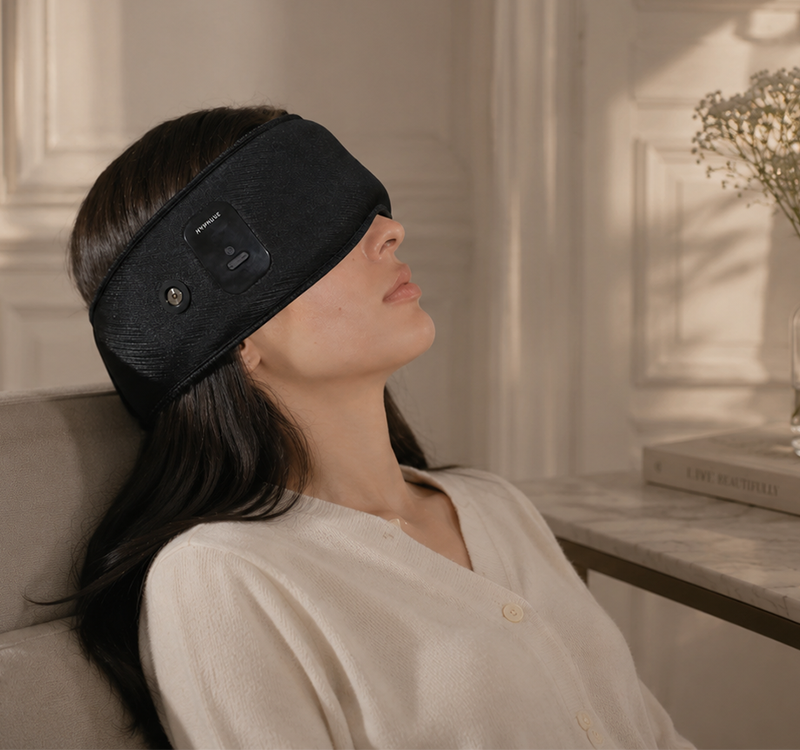
The most common failure of a cheap sleep mask is the gap at the bridge of the nose and along the cheeks. Hypnuse says its patented 3D contour is designed to eliminate light leakage in those areas, so that darkness holds regardless of face shape or sleeping position. Hypnuse also states that the contours were shaped using 3D facial scan data from more than 2,000 participants across different face shapes. As with any fit claim, the practical test is your own face, which is why a trial or return policy matters (more on that below).
2. Comfort: no pressure on the eyes
A mask you can't tolerate is a mask you won't wear. The design uses an elevated eye cavity so that fabric doesn't press directly on your eyes or lashes, which also lets you blink freely. Hypnuse lists its materials as 22-momme mulberry silk, slow-rebound memory foam and breathable fabrics, which are chosen for skin contact over a full night.
3. Warmth: a signal to let go of tension
Warmth around the eyes is a familiar comfort for many people, the same idea as a warm compress at the end of a long day. Hypnuse's masks with heating offer a hot compress with five adjustable levels, paired on some models with a soft red light. On the Pro model, the five levels run from 38 °C to 46 °C (about 100 to 115 °F). Starting low and moving up gradually is the sensible way to use any heated product near your eyes.
4. Guided breathing: giving your attention somewhere to go
Slow, paced breathing is one of the simplest and most widely used relaxation techniques. The challenge is that, when you are wound up, counting your own breaths in the dark tends to turn into another task. Guided breathing on the mask does the pacing for you, so your only job is to follow it.
5. Sound: masking the room
Select Hypnuse models include in-built speakers, Bluetooth audio and white noise generation. Sound serves two purposes during a wind-down: it softens sudden noises that might pull you back to alertness, and it gives your mind a steady, low-stakes thing to rest on. The Pro model lists 14 built-in soundscapes. Because the speakers sit in the mask, there are no earbuds to dislodge when you roll over.
6. Sensors: letting the session respond to you
This is what separates an AI sleep mask from a heated mask with a speaker. Models with sensors track heart rate in real time, along with pulse oximetry and motion, and sync with the Hypnuse app. In practical terms, that data helps the mask adapt its aids to how you are actually settling, and gives you a record to review in the morning.
If sleep data is new to you, our explainer on sleep stage tracking and why it matters is a good companion read. Treat any single night's numbers as a rough guide and look for patterns across weeks.
7. Intelligent wake-up: ending the night gently
Winding down is half the story. Hypnuse also lists an intelligent wake-up feature, so the mask can help bring the night to a close as well as start it. The aim is a less jarring morning than a standard alarm tone.
Feature availability differs by model. Check the product page for the specific mask you're considering: Hypnuse Pro: Immerse Edition, Hypnuse Rhythm, Hypnuse Hush or Hypnuse Core.
A Simple Wind-Down Routine With the Mask
A mask works best as part of a routine rather than a last-minute fix. This sequence is a starting point you can adjust. None of it is specific to one brand.
- Pick a start time you can repeat. Consistency matters more than the exact clock time. Choose a point in the evening you can realistically hit most nights.
- Prepare earlier in the day. Charge the mask in advance using its magnetic charging cable, so the routine is never delayed by a dead battery.
- Lower the room. Dim lights and put bright screens aside. The mask handles the light that remains, but a calmer room makes the transition easier.
- Start with warmth. Put the mask on and begin at the lowest comfortable heat level. Increase only if it feels good, and stop if it ever feels too warm.
- Follow the breathing guide. Let the pacing lead. If your mind wanders, you don't need to correct it. Just return to the next breath.
- Let sound do its work. Choose a soundscape or white noise level that is quiet enough to fade into the background.
- Review in the morning, not at 2 a.m. Look at the app for trends over several nights. Checking numbers mid-night tends to create the very alertness you are trying to avoid.
Who the Hypnuse AI Sleep Mask Suits
Different sleepers want different things from the same product. Here is how it plays out for four common groups.
People who struggle to switch off at night
If your difficulty is the "mind won't quiet" kind rather than a bright-room problem, the layered approach of heat, breathing and sound is the most relevant part. Treat it as a way to build a reliable pre-sleep ritual. If trouble sleeping is persistent, though, the right next step is a conversation with a clinician, not a gadget.
Tech-curious buyers comparing smart sleep gadgets
Many people considering a smart mask are also looking at rings, watches and bedside trackers. The tools do different jobs. Most wearable trackers are measurement tools. A smart mask is an intervention tool that also measures.
| Question | Typical sleep ring or watch | AI sleep mask |
|---|---|---|
| Main job | Measure sleep and daytime activity | Support the wind-down and measure the night |
| Blocks light | No | Yes |
| Active aids (heat, sound, breathing) | Limited or none | Yes, on supported models |
| When you wear it | Often around the clock | Only at bedtime and during naps |
| Daytime data | Broad | Not its purpose |
They aren't mutually exclusive. If you already own a tracker you like, a mask is an addition that acts on the evening rather than just recording the night.
Frequent travelers and shift workers
Two situations make darkness hard to control: a plane cabin and a bedroom at 10 a.m. A contoured blackout mask helps in both. For flights, a lighter option such as Hypnuse Core, a non-electronic travel mask, avoids charging and airline electronics questions entirely. If you use a model with speakers or heat on a plane, check your airline's rules on powered and Bluetooth devices first. For shift workers sleeping by day, a mask can work alongside blackout curtains and a consistent pre-sleep routine.


Stressed professionals building a calmer evening
For people whose evenings blur into work, the mask's real value may be the boundary it creates. Putting it on signals "work is over" in a physical way that closing a laptop doesn't. Hypnuse also positions the mask for meditation and quiet time at home, not just sleep.

Choosing the Right Hypnuse Mask
Hypnuse sells several masks that serve different needs. Prices below were listed on the Hypnuse site in October 2026 and may change.
| Model | What it is | Price (USD) | Best for |
|---|---|---|---|
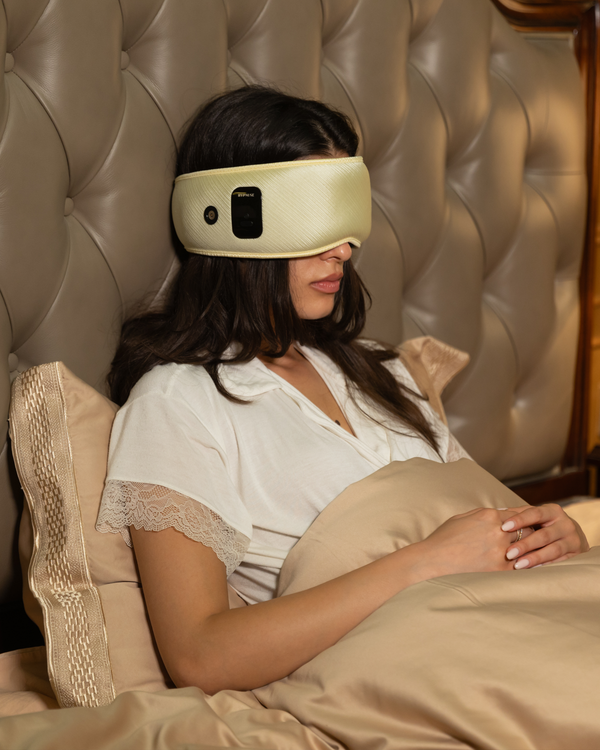
| Hypnuse Pro: Immerse Edition | Flagship AI sleep mask; available in black, gold and silver | $249 | The full wind-down experience with sensors, heat and sound |
| Hypnuse Rhythm | Intelligent heating eye mask in the AI sleep mask series | $199 | Warmth-led evening routines |
| Hypnuse Hush | Modular, 100% blackout sleep mask | $35 | Darkness first, without the electronics |
| Hypnuse Core | Non-electronic, portable travel mask | $15 | Flights, hotels and throwing in a bag |


A practical way to decide: if you are mainly fighting light, start with Hush. If you want warmth and a more active routine, look at Rhythm. If you want heart rate sensing, guided breathing and sound as well, that is the territory of the Pro. For a walkthrough of the technology behind the range, see the How It Works page.
What to Expect, and What It Can't Do
A trustworthy guide should be clear about limits, so here they are.
- It is not a medical device. It won't diagnose or treat insomnia, sleep apnea or any other condition. If you snore heavily, wake gasping, or feel exhausted despite long nights, see a healthcare professional. Hypnuse's own piece on how smart sleep masks monitor sleep apnea explains what this kind of data can and can't tell you.
- Results vary. Warmth, sound and breathing guidance help some people more than others. A sensible way to judge it is to use it consistently for a few weeks, not a single night.
- It needs charging. Electronic models run on a battery and charge via a magnetic cable. A forgotten charge means a night without the features.
- Fit is personal. Any mask, however well designed, can feel different on different faces. This is why a return policy matters.
- Data is a guide, not a verdict. Consumer sleep tracking gives useful trends but is not a clinical sleep study.
On the buying side, terms are listed differently across the site. The Hypnuse homepage mentions a 60-night trial, free shipping and a 2-year warranty, while the Hypnuse Pro product page lists a 90-day returns policy and a 6-month replacement warranty. Terms can differ by product, so confirm the current return and warranty policy for the exact model on its product page before you order.
A Buying Checklist for Any Smart Sleep Mask
Whether or not you choose Hypnuse, these are the questions worth asking before spending money on a smart sleep mask:
- Does it actually block light at the nose and cheeks? Look for a contoured design, not just a flat panel.
- Does anything press on your eyes? A raised eye cavity is more comfortable for many people than fabric resting on the lids.
- Which features does your specific model include? Heat, sound and sensors are often limited to certain models in a range.
- How is the heat controlled? Adjustable levels beat a single fixed temperature.
- What does the app do, and what does it cost? Check whether core features need a subscription.
- How long does the battery last, and how does it charge? A simple connector makes the nightly routine easier.
- What happens if it doesn't suit you? A clear trial and return policy is a good sign.
- Are the claims specific and sourced? Be cautious of products that promise dramatic results with no explanation.

Frequently Asked Questions
What is an AI sleep mask?
An AI sleep mask is a wearable eye mask that blocks light and uses built-in sensors and software to support winding down. Features usually include heat, sound, guided breathing and sleep data shown in an app.
Does a heated sleep mask help you fall asleep faster?
Warmth around the eyes feels relaxing for many people, which can help them settle before bed. Individual results vary, and a heated mask works best as one part of a consistent evening routine rather than a stand-alone fix.
How does the Hypnuse mask track heart rate?
Models with sensors include a heart rate sensor, a pulse oximeter and a motion sensor, and sync with the Hypnuse app so you can review your sleep data. Sensor availability depends on the model, so check the product page.
Is an AI sleep mask better than a regular sleep mask?
It depends on the problem. If light is your only issue, a quality blackout mask such as Hypnuse Hush may be all you need. If you also want warmth, sound, breathing guidance and sleep data, an AI sleep mask offers more.
Can I use it on flights or for naps?
Yes. Hypnuse positions its masks for flights, power naps at work, meditation and home use. For flights, a lighter non-electronic option like Hypnuse Core avoids charging, and you should check airline rules before using any powered or Bluetooth device onboard.
Does it replace medical advice for insomnia or sleep apnea?
No. It is a sleep-routine tool and not a medical device. If you have persistent trouble sleeping, loud snoring or daytime exhaustion, speak with a healthcare professional.
Which Hypnuse sleep mask should I choose?
Choose Hypnuse Hush for blackout darkness, Hypnuse Core for lightweight travel, Hypnuse Rhythm for a heat-focused routine, and Hypnuse Pro: Immerse Edition for the fullest set of features including sensors, heat and sound.
What are the trial, return and warranty terms?
Terms are listed differently across the Hypnuse site: the homepage mentions a 60-night trial and a 2-year warranty, while the Hypnuse Pro product page lists a 90-day returns policy and a 6-month replacement warranty. Confirm the current terms for your exact model on its product page before you order.
Bringing It Together
Winding down is a skill your body can relearn with the right cues, and a mask is one practical way to build them: darkness to remove the light, warmth to ease tension, breathing and sound to give your attention somewhere to rest, and sensors to show you whether it's working. The best choice is the one that matches your actual problem, whether that is a bright room, a busy mind, a long flight or a night shift.
To see how the range fits together, start at the Hypnuse homepage, read the How It Works page, or go straight to the Hypnuse Pro: Immerse Edition and the Hypnuse Hush eye mask to compare the two ends of the range.
This article is for general information and is not medical advice. Hypnuse masks are sleep-routine products, not medical devices.


