

You turn off the lamp, lie down, and your body finally stops moving. Your mind, on the other hand, picks that exact moment to replay the whole day. Sound familiar? Most of us don't have a "can't close my eyes" problem. We have a "can't switch off" problem. And one of the simplest tools for that second problem is something you already carry everywhere: your breath.
Quick answer: Guided breathing for sleep is a short, paced breathing practice done at bedtime, usually with a longer exhale than inhale, that helps your body shift from alert to relaxed. A simple version takes five minutes and needs no equipment. This guide gives you that routine step by step, explains why it works, and shows where a smart sleep mask that guides your breathing can make the habit easier to keep.
What Is Guided Breathing for Sleep?
Guided breathing for sleep is a structured breathing pattern, paced by a count, a voice, or a device, that you follow in the minutes before bed to help your body settle. The key word is "guided." Instead of deciding how fast to breathe while your mind is racing, you follow a rhythm someone or something else sets.
That matters more than it sounds. If you have ever tried to "just relax and breathe slowly" in bed, you know how quickly it turns into another task. You start counting, lose count, get annoyed at losing count, and now you are more awake than when you started. A guide takes the decision-making out of it.
Guidance can come from a few places:
- Your own counting: free and portable, but it asks for attention you may not have.
- A recorded voice or app: easy to follow, though it usually means holding a phone near your bed.
- A wearable: some smart sleep masks, including supported Hypnuse eye mask models, build breathing guidance into the mask itself, so there is no screen to check.
One thing to be clear about up front: this is a relaxation habit, not a medical treatment. It will not cure insomnia or sleep apnea, and we will come back to when to talk to a professional. What it can do is give your evening a repeatable, calming cue.
Why Slow Breathing Helps You Wind Down
Breathing is unusual because it runs on autopilot but you can also take over. That makes it one of the few direct handles you have on your body's stress response. When you are tense, breathing tends to get quick and shallow without you noticing. When you deliberately slow it down, especially by lengthening the exhale, many people find their body follows with a calmer pace.
Think of it like a dimmer switch rather than an off switch. You are not forcing sleep. You are turning down the alertness so sleep has room to arrive.
Here is the practical logic, without the jargon:
- A longer exhale feels like a signal to slow down. Many breathing practices for relaxation rely on this idea.
- Counting gives a busy mind a job. A simple, repetitive task crowds out the replay of tomorrow's to-do list.
- Repetition builds a cue. Do the same sequence at the same point each night and your body starts to associate it with winding down.
Results vary from person to person, and a single night rarely tells you much. Treat it like a habit you test for a couple of weeks rather than a switch you flip. For broader, trustworthy guidance on healthy sleep habits, the CDC's sleep resources are a good place to start.

Before You Start: Set Up Your Space
The routine itself is simple, but a few minutes of setup makes it noticeably easier to stick with. You do not need a perfect bedroom. You just need to remove the obvious friction.
- Dim the room. Lower the lights and put bright screens aside. Your breathing routine works better when light is not telling your brain it is still daytime.
- Get comfortable first. Lie on your back or your side, whichever you normally fall asleep in. Let your shoulders drop and unclench your jaw.
- Decide on one guide. Pick counting, an app, or a mask-based guide, and stay with it. Switching between methods mid-routine is its own distraction.
- Keep phones out of reach. Checking a notification halfway through resets everything.
- Block the light. A well-fitted blackout mask removes the last stray light from hallways or streetlamps, and a contoured design like the Hypnuse Hush is built for exactly that.
If you use a mask with electronics, charge it earlier in the day so the routine is never delayed by a dead battery. Small details like that decide whether a habit lasts a week or a year.
The Simple 5-Minute Guided Breathing Routine
Here is the routine, minute by minute. Breathe in through your nose if that is comfortable, and out gently through your nose or slightly parted lips. Keep every breath soft. This should never feel like effort.
- Minute 1: Arrive. Lie still. Breathe normally and simply notice the rise and fall of your chest or belly. Let your shoulders sink into the bed. There is nothing to fix yet.
- Minute 2: Find the rhythm. Begin counting. Breathe in for a count of 4, then out for a count of 4. Keep it even and unhurried.
- Minutes 3 and 4: Lengthen the exhale. Now breathe in for 4 and out for 6. If 6 feels like a stretch, use 5. The exhale should feel like a slow sigh, not a squeeze.
- Minute 5: Let go of the count. Stop counting. Keep the breath slow, and let your attention rest on the feeling of air moving, or on the warmth of the bed. If sleep arrives before the five minutes are up, you have done it right.
What to do when your mind wanders: it will. Every single time. Do not scold yourself and do not restart. Notice the thought, then return to the next breath. Returning is the practice, not a failure of it.
A realistic example: imagine someone who finishes a long workday at the laptop and heads straight to bed with their mind still in meetings. The first night, they lose count three times. By the second week, the routine feels familiar and the counting starts to fade into the background. That arc, awkward at first and automatic later, is normal. Give it a fair run before judging it.
Which Breathing Pattern Should You Use?
There is no single "correct" pattern. A few are popular for bedtime, and the best one is the one you will actually do. Here is how they compare.
| Pattern | Rhythm | Best for | Difficulty |
|---|---|---|---|
| Extended exhale | In 4, out 6 | Beginners and everyday use | Easy |
| 4-7-8 breathing | In 4, hold 7, out 8 | People who like a stronger, more structured count | Moderate |
| Box breathing | In 4, hold 4, out 4, hold 4 | A racing mind that needs a focused task | Moderate |
If you are new to this, start with the extended exhale. Breath holds can feel uncomfortable for some people, especially at the start, and there is no need to push into them. If any pattern makes you dizzy, tense, or anxious, go back to normal breathing and keep it gentle.
Common Mistakes That Keep the Routine From Working
Most people who say breathing exercises "don't work" are running into one of a handful of fixable habits.
- Breathing too deeply, too fast. Big, forceful breaths can leave you feeling wired. Aim for soft and slow, not deep and dramatic.
- Straining the count. If you are gasping to finish a long exhale, shorten the count. Comfort beats precision.
- Judging the first night. One session proves very little. Look at how you feel after a couple of weeks.
- Checking the clock. Time pressure is the enemy of relaxation. Turn the clock away.
- Using it as a last resort. Starting at 3 a.m. in frustration is harder than a calm routine at a set time. Make it part of your regular evening.
- Doing it in a bright, noisy room. The practice is easier when the environment is quiet and dark.
The common thread is trying too hard. The whole point is to let your body down gently, so if the routine starts to feel like a performance, ease off.
Where a Smart Sleep Mask Fits In
You do not need a gadget for any of this. A counted breath works perfectly well on its own. But some people find the habit easier to keep when the environment does part of the work, and that is where a smart mask comes in.
A mask can handle several of the setup steps at once: it blocks light, it can add gentle warmth, and on supported models it paces your breathing so you only have to follow along. On Hypnuse's range, guided breathing, built-in sound, and sensors that connect to an app are described across the AI sleep mask series, and which features you get depends on the model. The AI sleep mask wind-down guide walks through how those layers work together, and the How It Works page explains the technology behind it.
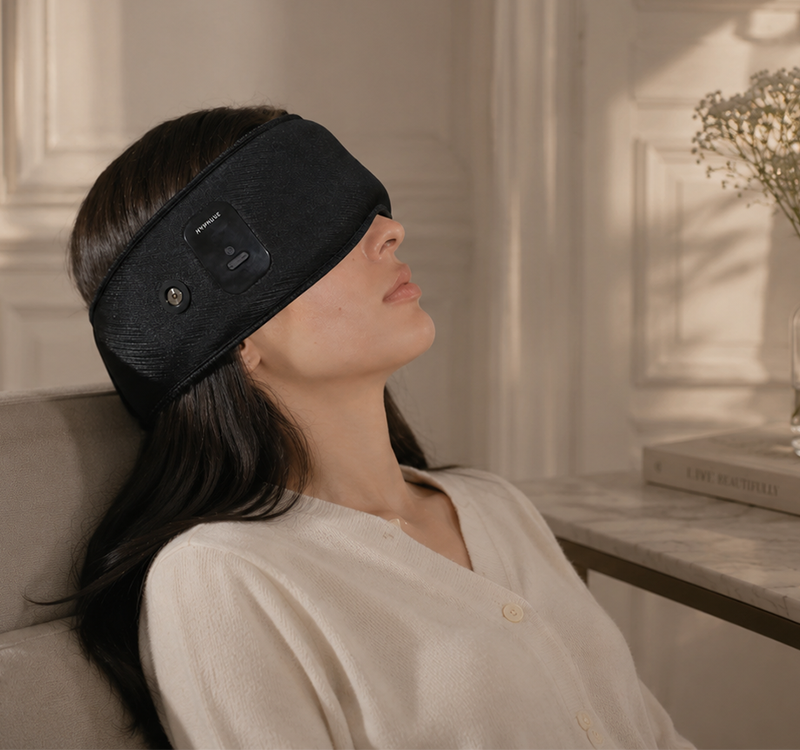
Here is how the options compare in practice:
| Approach | Cost | Pros | Trade-offs |
|---|---|---|---|
| Counting on your own | Free | Works anywhere, no setup | Needs attention you may not have at night |
| Phone app or recording | Free to low cost | Easy to follow | Screen and notifications nearby |
| Smart sleep mask | Higher | Darkness, warmth, sound, and breathing guidance in one wearable | Needs charging; features vary by model |
If darkness is your main issue, a simple blackout mask like Hypnuse Hush may be all you need. If you want a warmth-led routine, look at Hypnuse Rhythm. If you want guided breathing, sound, and sensors together, that is the territory of the Hypnuse Pro: Immerse Edition. Always check the product page for the exact features of the model you are considering, plus the current return and warranty terms before you order.
Building the Habit: A Two-Week Plan
The routine only works if it becomes automatic. Here is a realistic way to get there without turning it into homework.
- Days 1 to 3: do the five minutes, and do not judge the result. The goal is simply to repeat it.
- Days 4 to 7: anchor it to something you already do, such as brushing your teeth or plugging in your phone, so you do not rely on remembering.
- Days 8 to 14: notice how settled you feel as you start, and adjust the count to whatever feels most natural.
If you track your sleep, look at trends across weeks, not a single night. Hypnuse's explainer on sleep stage tracking is a good companion read, and the sleep hygiene guide covers the all-day habits that make a bedtime routine land better. You can also browse the Sleep Tips page for shorter ideas.

Safety and When to Talk to a Professional
Gentle, slow breathing is considered low risk for most healthy adults, but it is not right for everyone, and it is not a substitute for medical care.
- Stop if you feel dizzy, lightheaded, or anxious. Return to normal breathing. Never force a hold or a long exhale.
- Check with a clinician first if you have a respiratory or heart condition, are pregnant, or have been told to avoid breath-holding.
- Do not ignore persistent symptoms. Loud snoring, waking up gasping, ongoing trouble sleeping, or heavy daytime tiredness deserve a conversation with a healthcare professional. Hypnuse's piece on how smart sleep masks monitor sleep apnea explains what this type of data can and cannot tell you.
- Be careful with heat. If you use a heated mask, start at the lowest level and stop if it ever feels too warm.
Hypnuse masks are sleep-routine products, not medical devices. They support a bedtime routine and do not diagnose or treat any condition.
Bringing It All Together
A five-minute breathing routine will not fix every bad night, and it is not meant to. What it does is give your evening a reliable shape: a quiet signal that the day is over and your body can start letting go. Start with the simple version, counting in for 4 and out for 6, keep it soft, and give it a couple of weeks.
If you want help building the habit, a mask that blocks light and guides your breathing can take some of the effort out of it. Explore the Hypnuse AI sleep mask wind-down guide, compare the range on the eye mask collection, or go straight to the Hypnuse homepage.
Frequently Asked Questions
Does guided breathing really help you fall asleep?
Many people find that slow, paced breathing helps them relax before bed, especially when the exhale is longer than the inhale. Results vary from person to person, and it works best as part of a consistent evening routine rather than a one-night fix. It is a relaxation habit, not a treatment for a sleep disorder.
How long should I do breathing exercises before bed?
Five minutes is a practical starting point and is enough for most people to feel the shift from alert to calm. You can extend it if you enjoy it, but consistency matters more than length. Doing five minutes every night usually beats thirty minutes once a week.
What is the best breathing technique for sleep?
There is no single best technique. An extended exhale, such as breathing in for 4 and out for 6, is the easiest place to start. Some people prefer 4-7-8 or box breathing, but those include breath holds that can feel uncomfortable at first. Choose the one you can do gently and repeat.
Can a sleep mask guide my breathing?
Some can. Certain smart sleep masks, including supported Hypnuse models, include guided breathing along with light blocking, and in some cases heat, sound, and sensors that connect to an app. Features depend on the model, so check the product page for the one you are considering.
When should I see a doctor about my sleep?
See a healthcare professional if you have ongoing trouble falling or staying asleep, loud snoring, pauses in breathing, waking up gasping, or heavy tiredness during the day. Breathing exercises and sleep products can support a routine, but they are not a replacement for medical advice.
This article is for general information and is not medical advice.


